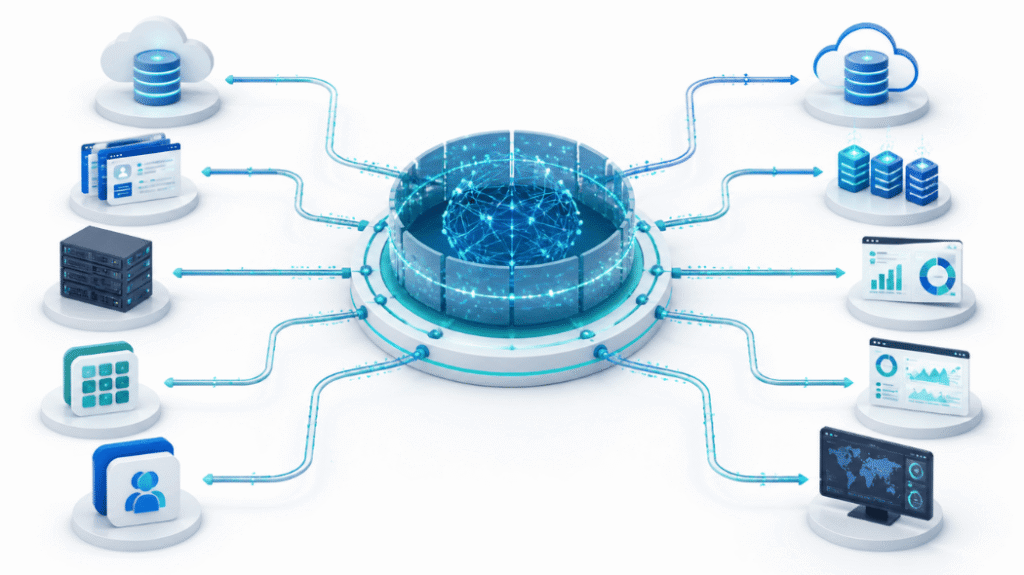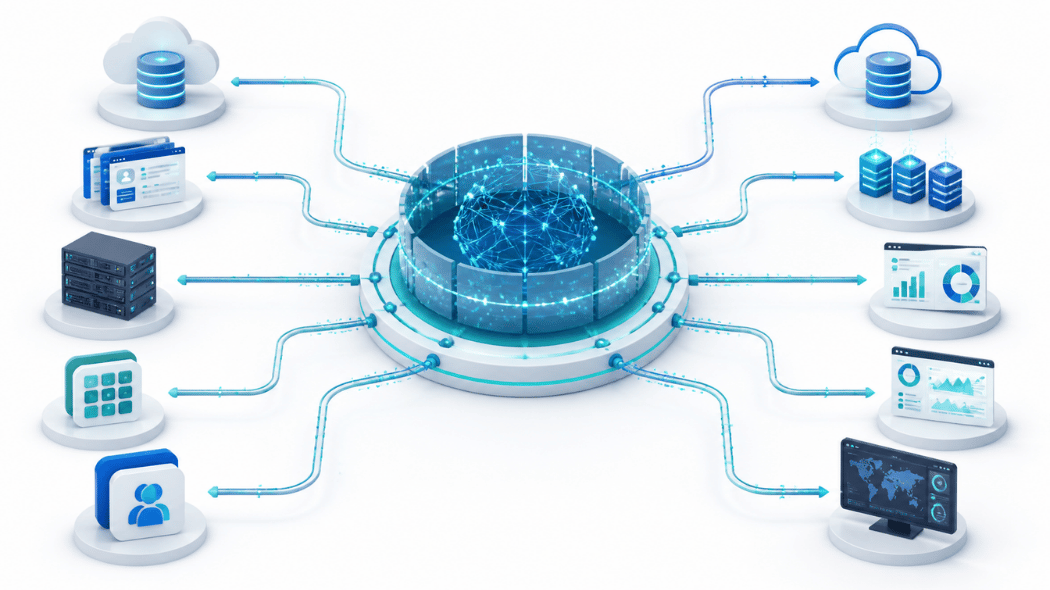
Businesses use multiple software applications to manage daily operations. Their customer records may sit in a CRM platform, while financial data remains in an ERP system. Marketing teams use separate tools, and operational information often comes from cloud applications or local databases.
This creates a common business problem. Employees cannot always access the information they need from one place. Teams may maintain duplicate records, repeat data entry, or spend hours searching for accurate information.
Data Fabric Architecture offers an approach to solving these challenges. It connects information across different systems and helps businesses manage data through a unified architecture.
Instead of moving every record into one central database, a data fabric connects distributed data sources. It helps users discover, access, manage, and govern information across the organization.
This approach is useful for businesses that work with large amounts of data across different platforms. It can also support analytics, automation, and better business decisions.
What Is Data Fabric Architecture?
Data Fabric Architecture is a data management approach that connects information across different sources, locations, and systems. It provides a unified way to discover, access, integrate, and manage distributed data.
A business may store information in cloud databases, on-premises servers, SaaS applications, and data warehouses. A data fabric helps connect these sources without requiring every system to use the same storage platform.
For example, an online retailer may store customer information in a CRM system. Its inventory records may sit in a warehouse management application. Payment details and sales reports may come from separate platforms.
A data fabric connects relevant information from these sources. Authorized employees can access a more complete view of business operations.
The architecture may use metadata management, data integration, automation, APIs, and governance tools. These components work together to make distributed data easier to manage.
Data Fabric Architecture does not mean that all business information must move into one location. Its purpose is to make data accessible and manageable across different environments.
How Does Data Fabric Architecture Work?
A data fabric connects multiple data sources through an integrated management layer. It uses different technologies to understand where information exists and how systems can access it.
The exact architecture depends on business requirements, existing infrastructure, and data complexity.
1. Connecting Different Data Sources
The first step involves identifying and connecting the systems that store business information.
These sources may include:
- Cloud databases
- On-premises servers
- Enterprise resource planning systems
- Customer relationship management platforms
- Data warehouses
- Data lakes
- SaaS applications
- IoT devices and connected equipment
Each source may use a different format or storage method. Data integration tools and connectors help establish communication between them.
For example, a company may connect its sales application with inventory software. This allows teams to compare customer orders with available stock.
2. Using Metadata to Understand Data
Metadata describes information about a dataset. It may include its source, format, owner, update frequency, and access permissions.
A data fabric uses metadata to understand available information across connected systems.
For example, a sales manager searching for customer purchase records may need to know which system contains the latest information.
Metadata helps identify relevant datasets and their relationships.
It also supports data discovery. Employees can find information without knowing the technical details of every connected application.
3. Integrating and Accessing Data
Once the sources are connected, the architecture helps users access information across systems.
Different integration methods may be used depending on the situation.
These can include APIs, data pipelines, data virtualization, and replication.
Data virtualization allows users to access information from different sources without always creating another physical copy. Data replication creates copies when performance, availability, or reporting requirements make it necessary.
The right method depends on how quickly information must be updated and how applications use it.
4. Applying Data Governance and Security
Businesses must control how employees access and use connected information.
Data governance establishes rules for data ownership, quality, privacy, and usage.
Security controls may include authentication, role-based access, encryption, and activity monitoring.
For example, a finance employee may access payment records, while a marketing employee only sees approved customer information.
These controls help businesses manage sensitive information across different platforms.
5. Automating Data Management Activities
Some data fabric platforms use automation to reduce repetitive management tasks.
Automation can help identify data quality issues, update metadata, monitor data pipelines, and recommend suitable datasets.
Machine learning may also help detect unusual patterns or suggest relationships between datasets.
However, automated recommendations still require appropriate oversight. Businesses should validate important data changes and maintain clear accountability.
Key Components of Data Fabric Architecture
A data fabric is not a single software product. It combines different technologies and management capabilities.
Data Integration
Data integration connects information from different applications and databases.
It helps systems exchange records and maintain consistent information across business operations.
Companies can use APIs, connectors, and integration platforms to establish these connections.
Metadata Management
Metadata management helps organizations understand their data assets.
It records details about data sources, ownership, formats, and relationships.
This makes information easier to discover and manage.
Data Catalog
A data catalog provides a searchable inventory of available datasets.
Employees can use it to find information, understand its source, and check whether they have permission to access it.
A well-maintained catalog reduces time spent searching for records.
Data Governance
Data governance defines how information should be collected, stored, accessed, and maintained.
It supports data quality, privacy, compliance, and accountability.
Data Orchestration
Data orchestration coordinates data movement and processing across systems.
It helps manage workflows that depend on information from multiple sources.
For example, a reporting process may need sales data, customer records, and inventory information. Orchestration helps coordinate the steps required to prepare that information.
AI and Machine Learning
AI and machine learning can support metadata classification, data discovery, quality monitoring, and automation.
These capabilities may help businesses manage complex data environments more efficiently.
Their effectiveness depends on reliable source information and appropriate controls.
Data Fabric vs Data Mesh vs Data Warehouse
Data Fabric, Data Mesh, and Data Warehouse are related to modern data management. However, they address different requirements.
A data fabric focuses on connecting and managing distributed information. A data mesh focuses on decentralized data ownership, with business domains responsible for their own data products. A data warehouse stores structured information for reporting and analytics.
| Technology | Main Purpose | Typical Use | Data Fabric | Connects and manages distributed data | Accessing information across different systems | Data Mesh | Distributes data ownership across business domains | Managing domain-specific data products | Data Warehouse | Stores structured data for analysis | Business intelligence and reporting |
|---|
These approaches are not necessarily competitors. An organization may use a data warehouse within a broader data fabric architecture. It may also apply data mesh principles to define ownership and responsibilities.
The best choice depends on the organization’s size, data strategy, and operational needs.
Benefits of Data Fabric Architecture for Businesses
Data Fabric Architecture can improve how organizations manage information across departments. Its value depends on the quality of implementation and the business problems it addresses.
1. Better Access to Business Information
Employees often work with information stored in different applications.
A data fabric helps connect these sources and makes relevant information easier to discover.
For example, a customer support employee may need purchase history, payment status, and delivery information. Connected data can help provide a more complete view.
This reduces the need to contact multiple departments for basic information.
2. Reduced Data Silos
Data silos occur when departments store information separately without effective connections to other systems.
They can create duplicate records and inconsistent reporting.
A data fabric helps connect these environments. It allows teams to access relevant information while keeping data in its existing systems when appropriate.
3. Improved Data Quality
Businesses need accurate information for reporting and operational decisions.
Data fabric tools can support data profiling, validation, and quality monitoring.
For example, a system may identify duplicate customer records or missing information in a connected dataset.
Employees can then investigate and correct the issue.
4. Faster Business Reporting
Preparing business reports can require information from several departments.
A data fabric can simplify access to these sources and support more efficient data preparation.
Managers can use connected information to review sales, inventory, customer activity, and operational performance.
The actual reporting speed depends on data volume, integration design, and system performance.
5. Support for Business Automation
Automation workflows often depend on information from multiple applications.
For example, an order processing workflow may need customer details, payment status, stock availability, and delivery information.
A connected data architecture can make these records easier to access.
Businesses exploring AI in business automation can use connected data as part of their broader automation strategy.
6. Greater Flexibility Across Cloud Environments
Many organizations use a combination of cloud services and local infrastructure.
A data fabric can help connect information across these environments.
This is useful when companies operate multiple applications or work with different cloud providers.
It also gives businesses more flexibility when changing applications or expanding their infrastructure.
Practical Use Cases of Data Fabric Architecture
Data Fabric Architecture can support different industries and business functions. The following examples show how organizations may apply it.
Banking and Financial Services
Banks manage customer profiles, transactions, loan applications, compliance records, and risk information.
These records may exist in separate systems.
A data fabric can connect relevant information and help authorized teams access a more complete customer view.
It can also support fraud monitoring and risk analysis when connected with suitable analytics systems.
Strict access controls remain important because financial information is sensitive.
Healthcare
Healthcare organizations manage patient records, appointment systems, billing information, laboratory results, and medical equipment data.
A data fabric can help connect these sources when systems support appropriate integration.
For example, an authorized healthcare professional may need information from a patient’s appointment history and laboratory records.
Connected information can reduce manual searching and support coordinated workflows.
Healthcare organizations must follow applicable privacy and data protection requirements.
Retail and E-commerce
Retail companies manage customer records, orders, inventory, payments, and delivery information.
A data fabric can connect these systems to improve visibility across sales and operations.
For example, a business may compare product demand with warehouse stock and supplier information.
This can help inventory managers identify shortages and review replenishment requirements.
Manufacturing
Manufacturing businesses collect information from production systems, quality management tools, suppliers, and connected machines.
A data fabric can help connect these sources for operational analysis.
Production managers may use information from machine sensors and inventory systems to understand delays.
They can then investigate whether equipment issues or material shortages are affecting output.
Telecommunications
Telecom companies manage customer accounts, network performance, billing records, and service requests.
A data fabric can help connect these datasets for authorized teams.
For example, customer support employees may need account details and service status while investigating a complaint.
Connected information can reduce the time spent switching between applications.
Data Fabric Architecture and Cloud Computing
Cloud computing plays an important role in many modern data environments.
Organizations often use cloud storage, databases, analytics platforms, and SaaS applications. Their information may also remain on local servers because of security, cost, or regulatory requirements.
A data fabric can connect these different environments.
For example, a company may store customer information in a cloud CRM platform and financial records in an on-premises ERP system.
The architecture can provide controlled access to relevant information across both systems.
Cloud services may also provide computing resources for data processing and analytics.
However, businesses should not assume that moving everything to the cloud automatically creates a data fabric. The architecture requires integration, metadata management, governance, and security.
Challenges Businesses Should Consider
Data Fabric Architecture can improve data management, but implementation requires careful planning.
Complex System Integration
Organizations may use older applications that lack modern integration features.
Connecting these systems can require custom development, middleware, or software upgrades.
Businesses should review their existing infrastructure before selecting a solution.
Data Quality Problems
A data fabric can connect information, but it cannot automatically make every source accurate.
Duplicate records, missing fields, and inconsistent formats can affect reporting and analytics.
Companies should establish data quality standards and assign responsibility for maintaining important datasets.
Security and Privacy Requirements
Connecting more data sources can increase the importance of access management.
Organizations must protect sensitive records and define who can access specific datasets.
They should also review applicable privacy laws and industry regulations.
Implementation Costs
Costs may include software licenses, integration services, infrastructure, employee training, and ongoing maintenance.
The total investment depends on the number of systems, data volume, and technical complexity.
Businesses should start with a focused use case and measure its value before expanding the architecture.
Employee Adoption
Employees may continue using spreadsheets or separate applications if the new system does not fit their workflows.
Training should explain how to discover data, request access, and use approved information sources.
Clear ownership also helps employees understand who maintains each dataset.
How to Implement Data Fabric Architecture
A practical implementation should begin with business requirements rather than software selection.
Step 1. Identify Data Management Problems
Review how departments currently store and access information.
Find areas where employees face duplicate records, reporting delays, or disconnected applications.
Choose a problem that has a clear business impact.
Step 2. Map Existing Data Sources
Create an inventory of databases, applications, cloud platforms, and local systems.
Record what information each source contains and which department manages it.
This provides a starting point for integration planning.
Step 3. Define Data Governance Rules
Establish data ownership, access permissions, quality standards, and privacy requirements.
Decide who can approve changes and who is responsible for maintaining important records.
Step 4. Select Suitable Integration Tools
Review platforms that support the required data sources and integration methods.
Consider APIs, connectors, metadata tools, data catalogs, and orchestration capabilities.
The selected tools should work with the organization’s existing infrastructure.
Step 5. Start With a Pilot Project
Choose one department or workflow for the first implementation.
For example, connect customer records with sales and support information.
Test data access, accuracy, security, and system performance.
Step 6. Monitor Results
Measure improvements in data discovery time, reporting speed, duplicate records, and manual work.
Compare these results with the original process.
Use employee feedback to identify areas that need adjustment.
Step 7. Expand Gradually
Once the pilot delivers measurable value, connect additional systems and departments.
Maintain governance and security standards as the architecture grows.
The Future of Data Fabric Architecture
Businesses are using more applications, cloud platforms, and connected devices than before. This creates a growing need to manage information across distributed environments.
Data Fabric Architecture can help address this requirement by improving data discovery, integration, and governance.
AI and machine learning may make data management more automated. These technologies can help classify datasets, identify quality problems, and recommend relevant information.
Businesses may also combine data fabrics with data lakes, warehouses, and analytics platforms.
However, technology alone will not solve every data management problem. Organizations still need clear ownership, reliable information, and suitable security practices.
Companies that build these foundations can create a more flexible data environment as their operational needs change.
Frequently Asked Questions About Data Fabric Architecture
1. What is Data Fabric Architecture in simple terms?
Data Fabric Architecture connects information across different applications, databases, and storage environments. It helps businesses discover, access, integrate, and manage distributed data.
2. What is the main purpose of a data fabric?
Its main purpose is to make information easier to access and manage across different systems. It helps reduce data silos and supports consistent data governance.
3. Is data fabric the same as a data warehouse?
No. A data warehouse stores structured information for reporting and analytics. A data fabric connects and manages information across distributed sources.
4. What technologies are used in Data Fabric Architecture?
Common technologies include APIs, data integration tools, metadata management, data catalogs, data virtualization, automation, and governance platforms.
5. Can small businesses use Data Fabric Architecture?
Yes. Small businesses can apply data fabric principles when they manage information across several applications. They can start with a limited integration project and expand as requirements grow.
6. How does a data fabric support AI?
A data fabric can help provide AI systems with access to relevant information from connected sources. It can also support data discovery and quality management. AI results still depend on data accuracy and appropriate controls.
7. Does Data Fabric Architecture require cloud computing?
No. A data fabric can connect cloud-based and on-premises systems. Businesses can choose an architecture that fits their infrastructure and security requirements.
Conclusion
Data Fabric Architecture helps businesses connect and manage information across different systems. It provides a structured approach to data integration, discovery, governance, and access.
Organizations can use it to reduce data silos and improve information availability across departments.
Successful implementation requires reliable data, clear ownership, and suitable integration tools.
Businesses should begin with one practical problem. They can then expand the architecture as their data requirements grow.